Specials
Functional & Regenerative Medicine
Close
Functional Medicine
Regenerative Medicine
Aesthetic Services
Close
Gut Health Testing
More
.png)
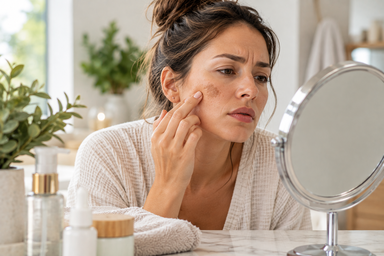
You've been diligent about sunscreen, you've tried the brightening serums lining every drugstore shelf, and that dark patch on your cheek or the uneven tone across your forehead just won't budge. It's one of the more stubborn skin concerns out there, and it's also one of the most misunderstood, because not all discoloration responds to the same treatment.
At New England Wellness Center in Hingham, Massachusetts, uneven skin tone is one of the concerns we field the most questions about. Understanding what type of discoloration you're dealing with makes a big difference in choosing the right approach, and chemical peels are often the most effective way to make real, visible progress.
This article has been updated for August 2026 with current insight from our Hingham skincare team.
Discoloration isn't one condition. It typically falls into a few different categories, each with its own underlying cause.
For many people, yes. Sun exposure triggers the skin to produce excess melanin as a defense mechanism, and over years of exposure, this can result in flat brown spots known as sunspots or solar lentigines, most commonly appearing on the cheeks, forehead, and hands.
This type of discoloration develops after the skin experiences trauma or inflammation, such as a healed pimple, a cut, or even an aggressive at-home exfoliation. The skin overproduces pigment in the area as it heals, leaving behind a mark that can take months to fade on its own, if it fades at all.
Melasma is a more complex form of hyperpigmentation often triggered by hormonal changes, such as pregnancy or birth control use, combined with sun exposure. It typically appears as larger, symmetrical patches, often across the cheeks, upper lip, or forehead, and tends to be more resistant to standard treatment than sunspots.
Absolutely. A buildup of dead skin cells can make discoloration look more pronounced by creating a rough surface that catches shadows and light unevenly, which is part of why skin can look blotchy even when actual pigmentation is mild.
Over-the-counter brightening products often contain lower concentrations of active ingredients compared to professional treatments, meaning they work slowly, if at all, on more established pigmentation. They also can't physically remove the damaged outer layers of skin the way a clinical treatment can, which limits how much visible change they're capable of producing on their own.
Chemical peels use a controlled application of acid solutions to exfoliate the skin at a deeper level than at-home products can reach, encouraging the outer, pigmented layers of skin to shed and reveal fresher, more evenly toned skin underneath.
A licensed provider applies a peel solution tailored to your specific skin concerns and tolerance level. Depending on the strength of the peel, you may feel a mild tingling or warming sensation during application. The solution is left on for a specific amount of time before being neutralized or removed, and the skin then begins a natural shedding process over the following days.
Chemical peels tend to be particularly effective for:
Melasma can also respond to peels, though it often requires a more cautious, gradual approach alongside diligent sun protection, since melasma is more prone to rebound if the skin is over-treated.
Recovery depends on the depth of the peel. Lighter peels typically involve mild flaking for a few days with little to no downtime, while deeper peels may involve more noticeable peeling over a week or so. Your provider will walk you through exactly what to expect based on the specific peel chosen for your skin.
Chemical peels work well on their own, but they're also frequently combined with other treatments for a more comprehensive approach. Clients dealing with textural concerns alongside discoloration sometimes pair peels with our dermaplaning service, while those wanting to address deeper collagen loss in addition to tone often ask about our collagen induction therapy. For a more surface level refresh, some clients start with a HydraFacial before working up to a peel. Our team will evaluate your skin during a consultation to recommend the safest and most effective sequence.
This varies significantly based on the type and severity of discoloration. Sun spots and mild post-inflammatory marks may show noticeable improvement after just a few sessions, while melasma and deeper pigmentation often require an ongoing series of treatments combined with strict sun protection to maintain results over time.
Can chemical peels completely remove dark spots? Many clients see significant fading, and some spots resolve almost entirely, though results depend on the depth of pigmentation and the number of sessions completed.
Are chemical peels safe for sensitive skin? There are peel formulations designed for varying skin sensitivities, and your provider will select the appropriate strength based on your skin type and tolerance.
How long does it take to see results after a chemical peel? Many clients notice brighter, more even toned skin within one to two weeks as the skin completes its natural shedding process.
Will my dark spots come back after treatment? Ongoing sun protection is essential for maintaining results, since unprotected sun exposure can trigger new pigmentation even after successful treatment.
Is there a difference between peels for acne marks versus sun damage? Yes, different peel formulations and strengths are often chosen depending on the type of discoloration being treated, which is why a personalized consultation matters.
Uneven skin tone can feel like a losing battle when you're relying on creams alone, but the right professional treatment can make a real, visible difference. Our team at New England Wellness Center in Hingham can help you understand exactly what type of discoloration you're dealing with and the best path forward.
Visit our homepage to learn more about our practice, browse our treatments page for additional services, or head to our contact page to schedule your chemical peel consultation.